
Officially Outlining!
I've finished my chapter-by-chapter outline—now, to just fill in the gaps!

This is week three of documenting the writing process for Rain, the coming-of-age romance novel I’m writing this year. I invite you to join me in writing a book in 2026!
Where are you at in your writing process? Tell me in the comments!

Forgive my incessant lateness. I forgot what day it was. Truly. I was knee-deep in other work, and didn’t realize I forgot to write this after completing my outline.
But here I am! I’m proud to report that I’ve finished the chapter-by-chapter outline.
And I have a scary statistic (sorry if all you pantsers out there have a heart attack):
My outline is nearly 16,000 words.
Yeah…I plan everything thoroughly. I don’t leave out a single detail, and I walk myself through every scene and interaction during the outline so I don’t miss anything even minute that I’ll need to remember when writing.
This doesn’t work for everyone, and that’s okay. But it’s what I need to do if I want to avoid having draft after draft once the first draft is finished.
If you’d like to avoid having fifteen drafts after your first, I also suggest getting down into the nitty-gritty details on your outline if possible.
How did I go about outlining?
For me, outlining works best when I jump right into the chapter-by-chapter outline and go from start to finish. My outlines are incredibly detailed, and although that doesn’t have to be the case, it does making writing ten times easier when you get to the drafting process.
Here’s an example of what one of my chapter-by-chapter outlines looks like:
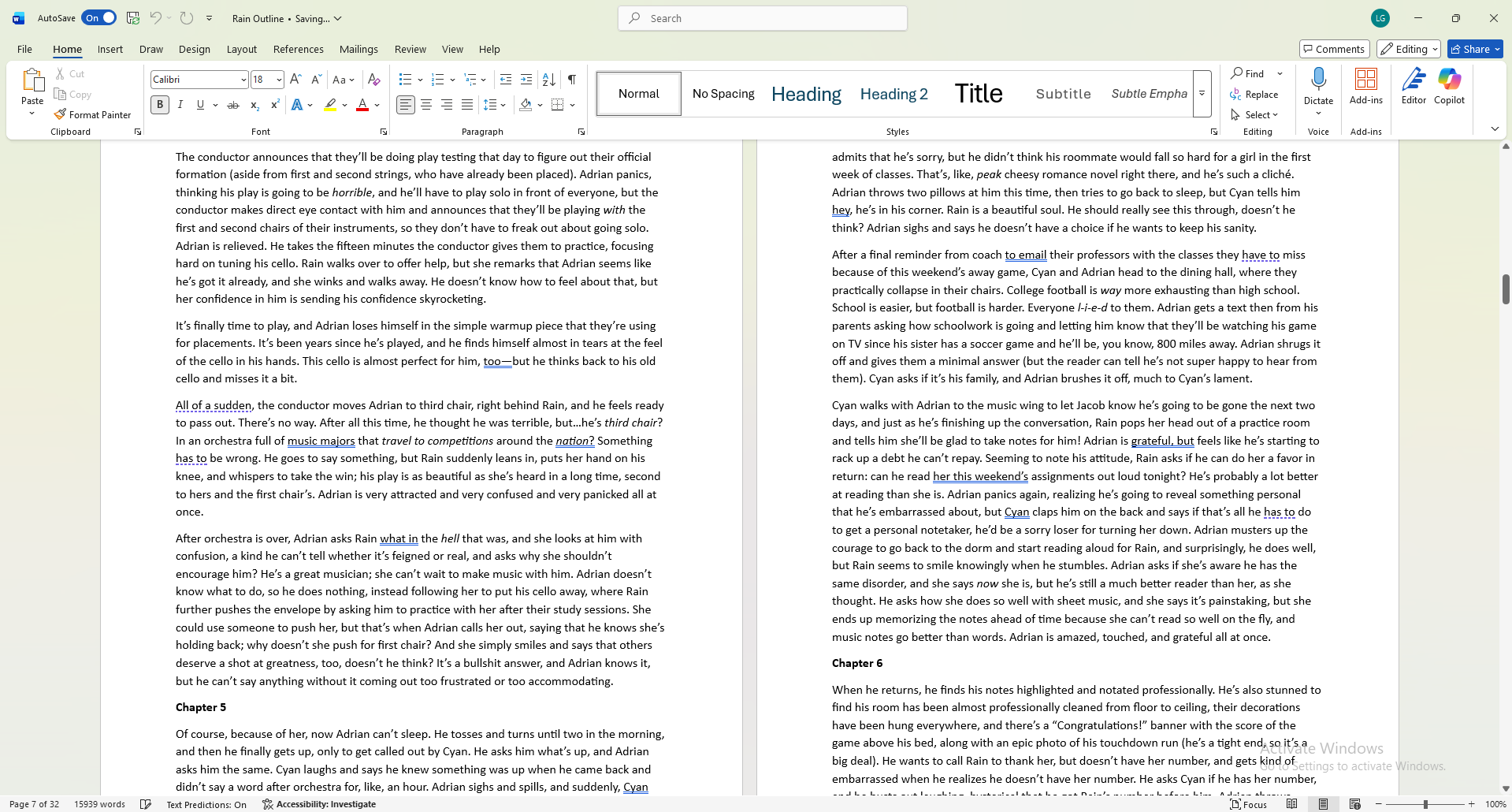
Yes, Chapter 5 takes up an ENTIRE page. You’re not seeing things.
My outlines are typically this complex and detailed. For example, I wrote a series outline once for a trilogy that was well over 20,000 words of details, worldbuilding, chapter outlines, character arcs, and more.
If this is your first time writing an outline, do not go for this level of detail. I’ve been doing this for years now, and this is what works for me. You have to find what works best for you.
Instead, I highly suggest starting out with bullet points. Using small tidbits of information to start, just to get from the beginning to the end of your book, is a great way to get used to following through on your ideas. By starting small, it’s not as big a deal to start expanding the information from there.
What does my plot look like so far?
In short, I’ve got my inciting moment, main arcs, and climax all set up. So far, it seems that I don’t have any glaring plot holes, but it’s up to the review process to investigate further now.
There is no set number of arcs that makes or breaks a book. In Rain, I’ve set up the following arcs:
Acknowledgement of conflicts (internal & external)
Self-exploration
Romantic exploration & conflicts
Self-destruction
Rebuilding
Final push
Some of these arcs overlap, but for the most part, they’re on their own and are easily identifiable among the overall plot.
My story follows a freshman college football player named Adrian, so his point of view is the only one I’m worrying about (Rain only has a couple of flashback chapters from her point of view toward the end).
Just because I have one point of view, though, doesn’t mean I’m not considering the other characters’ arcs. You have to acknowledge the role other characters’ development plays into the main character’s own development.
Adrian is falling in love with Rain throughout the story, but Rain is falling in love with Adrian, too. Her own internal conflicts and her reactions to them play a significant role in the decisions Adrian makes throughout the story.
Plus, Adrian’s friend and roommate, Cyan, has his own little arc alongside his story. Cyan greatly influences how quickly Adrian owns up to and grows from his decisions. Without Cyan, Adrian’s story would have had a much rockier middle and ending.
This is where things can get tricky if you have multiple main characters or a lot of characters in general: you have to balance out everyone’s arcs and confirm motivations at every turn. Since I only have one main character and two main supporting characters to deal with, I have a lot less going on, and the outlining process isn’t taking me as long.
If you have multiple main characters and tons of side characters, people are going to be influencing each other in complex ways. You’ll want to spend a long time with the outlining process to make sure you’re accounting for everyone’s motivations and accurately capturing the consequences of each turning point in the story.
I know this is a lot. It helps to have a guide! I’ll be releasing one alongside Friday’s deep-dive post to help you out.
Again, there’s a review process after initial outlining for a reason. Your original ideas may need some reworking, and that’s okay. As long as you keep writing down what you’ve got and connecting the dots, you’ll get there! Take it one step at a time!
What do I have left to do?
Oh, don’t you worry—I have plenty left to do! I still need to review the plot, identify any plot holes, and fill in my characters’ arc maps.
That’s a LOT of legwork left to go before the drafting process, but I’m ready for it.
Like I said, I prefer slaving over my outline to ensure a high-quality first draft to pantsing and editing the crap out of my story later.
This works for me; you have to do what works for you!
If you’re not sure where to start or how to go about the outlining process, be on the lookout for Friday’s post, which will go in-depth about the outlining process. I’ll also be releasing a free guide to help walk you through the process step by step!
See you next week!
Thanks for reading! I hope you’re making progress right alongside me as I write Rain this year.
Know someone writing a book this year? Invite them to join the community!
Want professional assistance with writing your book? Find a time to chat with my Calendly link below! As always, paid subscribers get discounts and freebies with my professional services, like developmental editing and book coaching.
This is exactly my experience. I started to write my novel in a discovery way but soon I got stuck.
It took me 4 months to write an outline (6 drafts). They all look like mini chapters and when a dialogue came to me I just wrote it down. Some ideas can’t wait.
There’s one thing about the outline that I don’t see it mentioned often or at all: you “see” the beginning and the end of your story and that alone gives you such a satisfaction. Like you did it. You have the story, even though it’s not final. But you see the end and that’s very empowering.
Currently writing the first draft of my debut 😄